In summary
95% of AI pilots never scale (
MIT Project NANDA, 2025). Yet, organisations that successfully industrialise generate a measurable EBIT impact within 6 to 12 months (
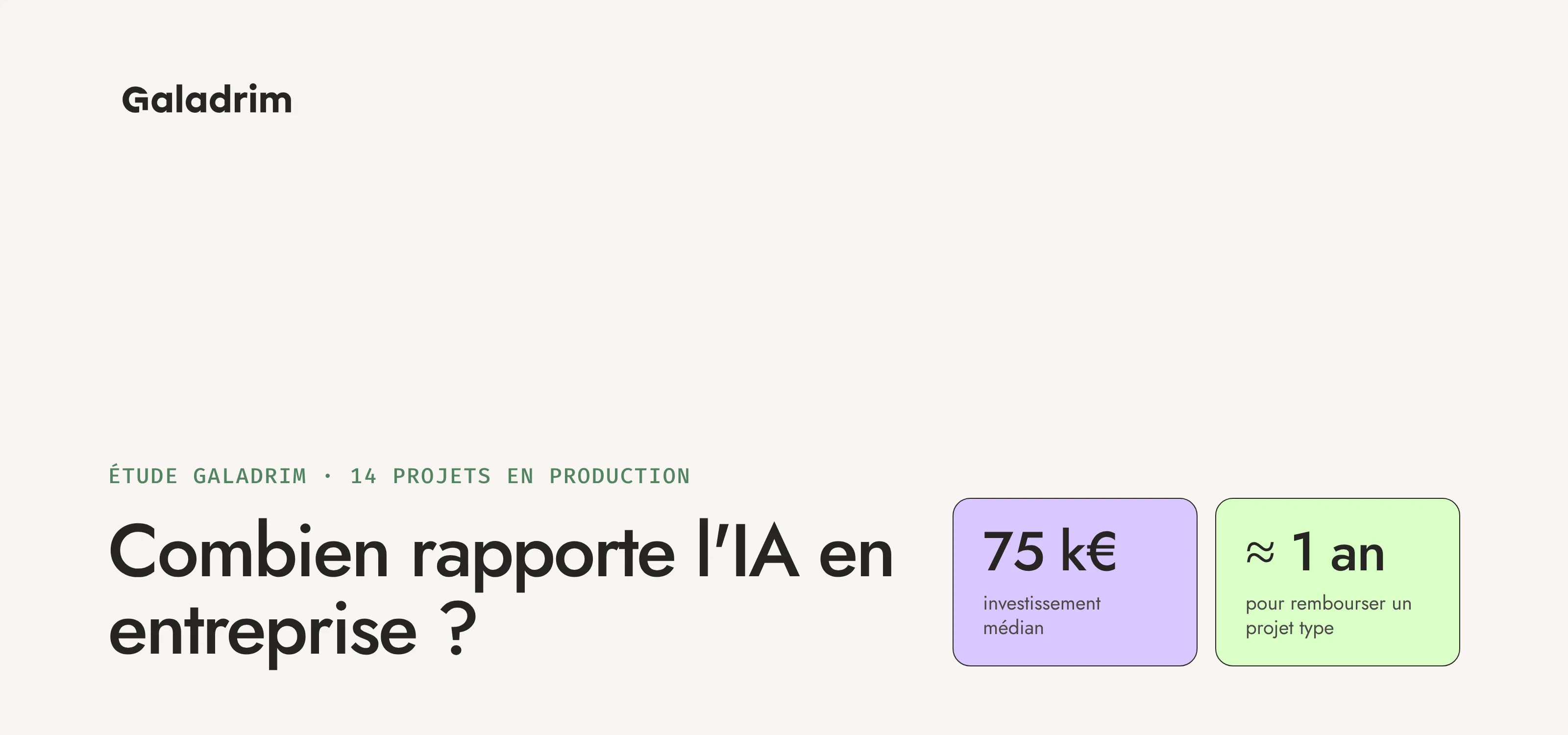
McKinsey Global AI Survey, 2025). The difference doesn't come from the chosen AI model but from the method. At Galadrim, we apply a 4-step approach: prioritise by ROI, remove upstream blockers, document processes, organise AI/human collaboration.
Why so many AI projects don't generate the expected results
Three causes often recur:
No business framing. The project starts with the technology ("we want to do RAG") rather than the problem ("we lose 2 hours a day processing incoming emails").
No budgeted industrialisation. The POC cost €40,000. Its actual production deployment costs €400,000 (infrastructure, security, integration, operational maintenance, training).
Vague KPIs. "Improve employee experience" is not a KPI. "Reduce customer file processing time by 30%" is one.
The Galadrim method in 4 steps
1. Gather requirements and prioritise according to ROI
We quantify the expected gain for each use case and rank projects by profitability. Only projects with a proven return proceed to the development phase.
Our scoring framework is based on four dimensions:
| Dimension | Minimum threshold | Why |
|---|
| Volume | To be determined | Justify the investment |
| Manageable complexity | Explainable business logic | Avoid hallucinations |
| Data availability | Clean and accessible data | No data, no project |
| Measurable impact | Quantifiable time savings, error reduction, or revenue | Demonstrate the ROI |
2. Address blockers: sovereignty, security, regulation, feasibility
Sovereignty, GDPR,
AI Act, technical feasibility: we decide from the outset on the choice of infrastructure (US cloud hosted in Europe or sovereign hosting) and models (proprietary or open).
This step avoids unpleasant late surprises: a project rejected by the legal department after 3 months of development, a model that needs to be changed en route, or a sovereignty constraint discovered at the time of deployment. We address these issues before the first line of code.
3. Review and document business processes for AI
We map existing processes, simplify them when necessary, and document them before automating. This step prevents the industrialisation of inefficiencies.
A vague business process leads to an AI that hallucinates. A well-documented business process leads to an AI that executes correctly. This step, often overlooked, is what distinguishes projects that work in production from those that fail at scale.
4. Define a process where AI and humans collaborate
The agent performs repetitive tasks, the human validates sensitive decisions. We define escalation thresholds and action traceability upstream.
In practice, for each use case, we answer: what actions can the agent take independently? What actions must be validated by a human? What criteria trigger an escalation? What events are tracked and auditable? This operational governance is as important as the AI model itself.
A real-world case: Odealim
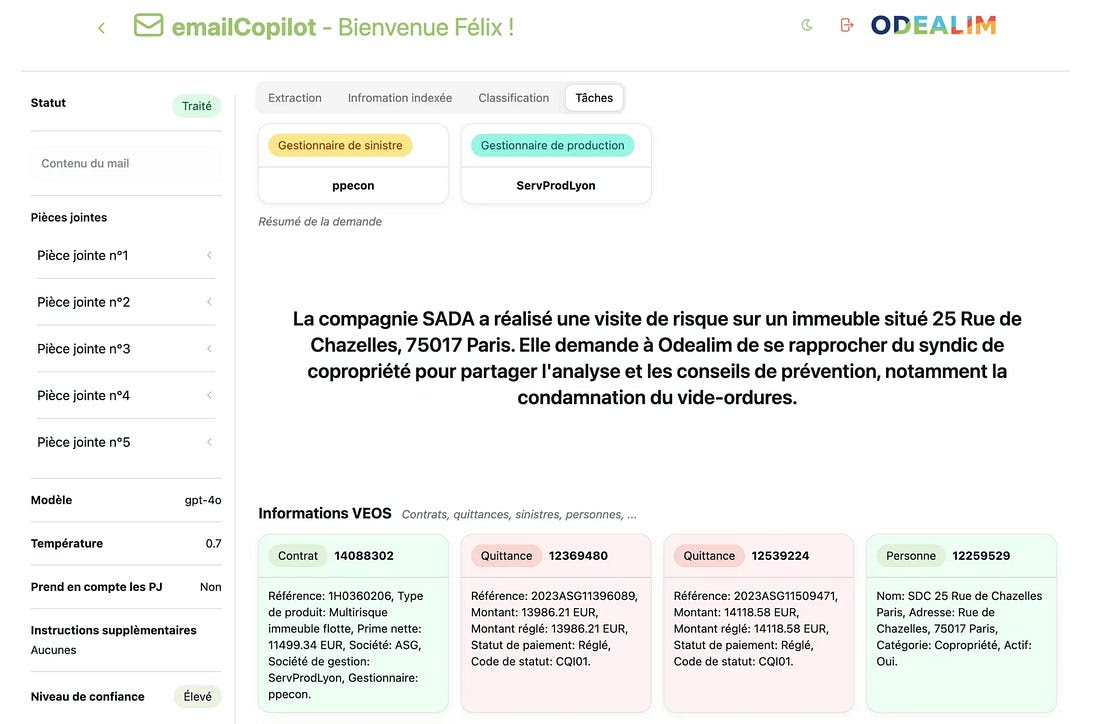
The Odealim Group, an insurance broker (€165M turnover, 900 employees), receives tens of thousands of customer requests by email each month. Difficult to process at scale without degrading service quality or causing significant delays.
We designed and deployed
emailCopilot, a system of
AI agents based on LLMs, which classifies requests, searches for useful data in customer files and contracts (guarantees, premiums), and generates response proposals. Managers validate or adjust from a dedicated interface, a direct application of our step 4 (AI/human collaboration).
Measured results:
200 daily users across operational teams (production management, claims, accounting).
50,000+ responses per month processed with AI assistance.
+150% productivity targeted within the deployed scope.
The project started with an 8-day framing phase (ROI prioritisation on 12 candidate use cases, 4 selected), a sovereignty/infrastructure arbitration, documentation of managers' business processes, then an industrialised POC in 6 weeks with daily supervision from day 1.
About the author, Benjamin Drighès is a Partner and AI CTO at Galadrim, a French tech & AI agency based in Paris, Nantes, and Lyon. He has led over 100 AI projects since 2017 for clients such as BNP Paribas, Carrefour, Showroomprivé, Odealim, Stellantis, and Chanel. Galadrim is a winner of the Top AI Awards 2024 (e-commerce category, IFOP Group) for the Scriptor solution developed for Showroomprivé.
Do you have an AI project stuck at the POC stage, or do you want to get off to a good start? Let's discuss your case.

_Z29Ubp8.webp)