In brief: there is no single price. The cost of an AI project depends first on the use case and the value it generates, then on two distinct items: the development of the solution (a one-off cost) and the consumption of the models once in production (a recurring cost). The right approach is to evaluate the balance between cost and benefit, use case by use case.
At Galadrim, a tech agency founded in 2017 that has supported over 800 clients, the AI branch deals with these questions daily, from startups to large corporations. Here's how the cost of an AI project is structured.
Why there's no 'price for AI'
The cost of an AI project only makes sense when viewed in relation to the value it brings. The same AI component can cost a few pence or several hundred euros per day depending on the task, volume, and required performance level.
In practice, cost is not even the first question for businesses. They first seek to unlock a use case : automate a task, process documents, direct customer requests. Cost becomes a concern once feasibility is demonstrated, and it is then finely managed.
What are the two main cost items for an AI project?
| Item | Nature | What it covers |
|---|
| Development | One-off cost | Needs assessment, solution design, integration into the information system, testing, deployment. |
| Consumption (run) | Recurring cost | Calls to AI models (billed per usage), hosting, monitoring, maintenance and enhancements. |
Many companies underestimate the second item. An AI solution is not a static deliverable: it consumes resources with each use and requires ongoing monitoring (model updates, deprecation of older versions, optimisations).
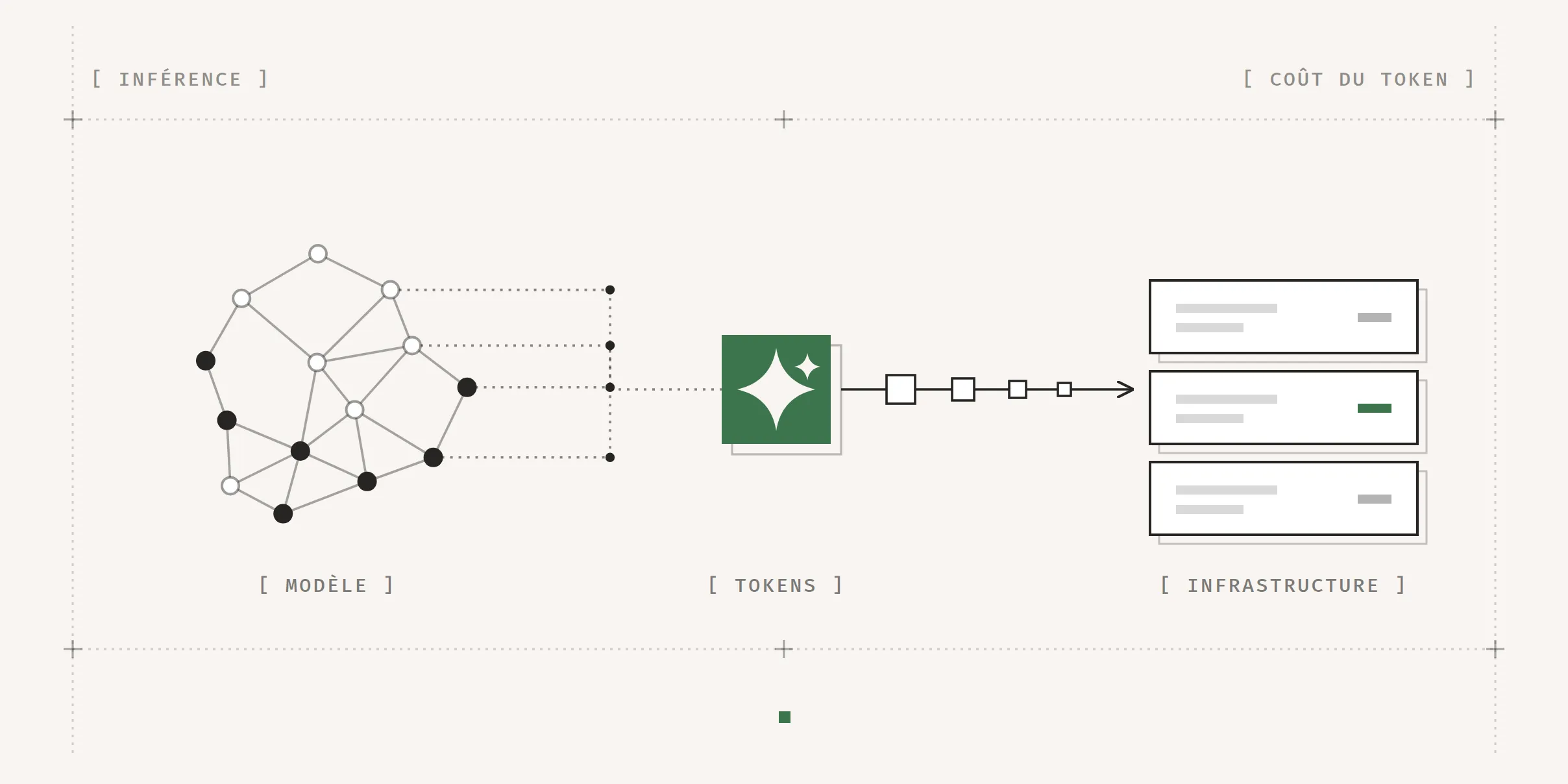
Most enterprise projects rely on the API of models, most often via cloud providers (for data security guarantees). Billing is then consumption-based, in tokens (the text units processed by the model), with two components:
The input cost (input) : all the context sent to the model (the prompt, the documents, the data).
The output cost (output) : the text generated in response.
Key point often overlooked: the output token generally costs 5 to 10 times more than the input token. Direct consequence on the cost of a use case:
Low-cost task (lots of input, little output): classify an email, direct a request to the correct department, extract information. Concrete example: automatically directing requests to the correct handler at an insurance broker, this is classification and therefore not very output-intensive.
More expensive task (lots of output): generate articles, produce long-form content.
Alongside consumption-based billing, there are subscriptions (especially for code agents used internally by tech teams), often more economical for intensive use.
An often underestimated point: recent models are « thinking » models, which reason before responding, and these reasoning tokens are billed as output. Consequence: the higher the level of reasoning you set, the higher the bill. Worse still, frontier models tend to mask these thinking tokens : you then pay for output tokens that you don't even see. This is a cost item to monitor closely as soon as advanced reasoning is activated.
Why do we hear that AI costs have exploded?
This is one of the most common misconceptions. For equal intelligence, the unit price of the token hasn't exploded; it has actually decreased. A token produced by a small, recent model can be as « intelligent » as a token from a large model of yesterday, for less.
So where does the increase in bills come from? From agentic workflows. An AI agent is not content with just one answer: it chains together steps, calls tools, and makes round trips. It therefore consumes many more tokens but also unlocks use cases previously impossible. The question always remains the same: what value does the workflow generate compared to its cost?
An additional market effect: certain uses were implicitly subsidised by providers via subscriptions. Very high consumers are now switching to consumption-based billing, which is less subsidised, hence a perceived increase, without the price of the token itself having spiralled.
Cost is not inevitable: it is managed through engineering. Four concrete levers:
Frame the agent's « harness ». The harness is the set of tools and rules made available to the model. Safeguards are encoded there, for example, stopping after five calls, directly in the code rather than in the prompt, because the code is deterministic and therefore more reliable for controlling expenditure.
Choose the right model level. We can think in terms of three levels: nano/mini (fast, economical), normal, and pro (the most powerful, the most expensive). The right method: start with a « frontier » model to prove feasibility, then step down a level as long as performance does not degrade. A simple classification works very well on a small model; a creative task justifies a high-end model.
Implement an evaluation mechanism. A reference dataset and metrics (quality, latency, cost) enable objective comparison of models and versions, and allow for downgrading without loss of quality.
Leverage supplier optimisations. Caching (reusing an already processed context) and flex pricing (accepting a longer response time for a reduced rate) reduce the bill for non-urgent tasks.
How much does it cost, practically?
Here are the orders of magnitude that structure a budget:
A simple classification or extraction task (sorting an email, reading an invoice) costs a fraction of a penny per call: at scale, this is often negligible compared to the human time saved.
A content generation task mobilises a lot of output tokens: the unit cost is higher and deserves monitoring.
An agentic workflow (search, document analysis, multi-step automation) is the most variable item: its cost depends on the number of back-and-forths, which are limited by engineering.
Development remains, in the majority of projects, the main item at launch; consumption becomes critical as volumes increase.
Should one favour a proprietary, open-source, or sovereign model?
The choice of model has a direct impact on cost and other criteria (security, sovereignty). An agency independent of AI providers has an advantage here: it can remain model-agnostic and select, for each task, the best value/cost ratio, or even change models along the way.
Open source is relevant, particularly in contexts of sovereignty (for example, a model hosted on GPUs in France, with a provider like OVH, in the health sector). But beware: running open source model inference yourself is a costly business, requiring scale and reliability. Most often, using an inference provider or a cloud provider remains the most cost-effective and stable solution.
About the author
Benjamin Drighès is AI CTO and partner at Galadrim. He joined the agency in early 2024 to create its artificial intelligence and data branch, and today manages about forty engineers and consultants. Daily, he supports SMEs, ETIs and large corporations in the design and production of AI solutions, with a pragmatic approach focused on business value.
Founded in 2017, Galadrim is a French tech and AI agency that has supported over 800 clients on their bespoke development and artificial intelligence projects.
Do you have a use case in mind and want to estimate its cost and ROI? Galadrim's AI teams support SMEs, ETIs and large corporations, from feasibility demonstration to production, whilst remaining independent of model providers.

_ZWR7SP.webp)