In brief: there's no single answer. The right choice depends on the use case, the required performance level, security and sovereignty constraints, and cost. A proprietary « frontier » model is essential when the latest capabilities are needed; open source becomes relevant for simpler tasks or in a sovereignty context. The best approach is to remain agnostic and to evaluate, for each task, the best value/cost ratio.
At Galadrim, a tech agency founded in 2017 that has supported over 800 clients, this question systematically arises, from startups to large corporations. Here's how we address this question at Galadrim.
What's the difference between a proprietary, open-source and sovereign model?
| Model type | Definition | Examples | To favour when… |
|---|
| Proprietary (frontier) | Closed models, accessible via API, at the cutting edge of capabilities. | Claude, GPT, Gemini | You need the best performance or feasibility is not guaranteed. |
| Open source | Models whose weights are open, deployable with an inference provider or in-house. | Mistral, Llama | The task is simpler, or you want more control and cost management. |
| Sovereign | Approach (often open source) guaranteeing data hosting and processing in Europe. | Open-source model hosted on GPUs in France | You have strong sovereignty or data localisation requirements. |
Please note: « sovereign » is not a separate model type, but a requirement which most often translates into an open-source model hosted in Europe. Sovereignty is therefore not just about « choosing Mistral »: it's a broader subject than merely the choice of model.
When should you choose a proprietary (frontier) model?
Cutting-edge proprietary models remain essential in two situations:
When feasibility is not guaranteed. In the development phase, the primary objective is to prove that a task is automatable. We then start with the best available model to remove any doubt, without immediately limiting ourselves on cost.
When the task is complex or creative. Rich content generation, advanced reasoning, understanding the subtext of an instruction: frontier models better guess the intention and produce a more aligned result.
In these cases, paying for a premium model is often the best investment, as the value generated far exceeds the additional cost in tokens.
When does open source make sense?
Open source is progressing and becoming a real option, particularly in two cases:
Simpler tasks (classification, information extraction) where a modestly sized model perfectly meets the objective, at a reduced cost.
Sovereignty contexts, where control over hosting and data is paramount.
A concrete example: in the healthcare sector, for a software publisher, we implemented an AI component based on an open-source model running on GPUs in France (with a provider like OVH), specifically to meet its sovereignty constraints.
What is a sovereign model and when do you need one?
Sovereignty addresses a clear need: to ensure that processed data remains in Europe, under a controlled legal framework. Many companies express it directly (« I want sovereignty, so Mistral »), but the subject is more complex than just the model's name. You also need to decide where and how the model is hosted and operated.
This is typically a requirement for regulated sectors (health, finance, public sector) and large corporations sensitive to the location of their data. In these cases, an open-source model hosted on European infrastructure is often the right answer.
Should you host an open-source model yourself?
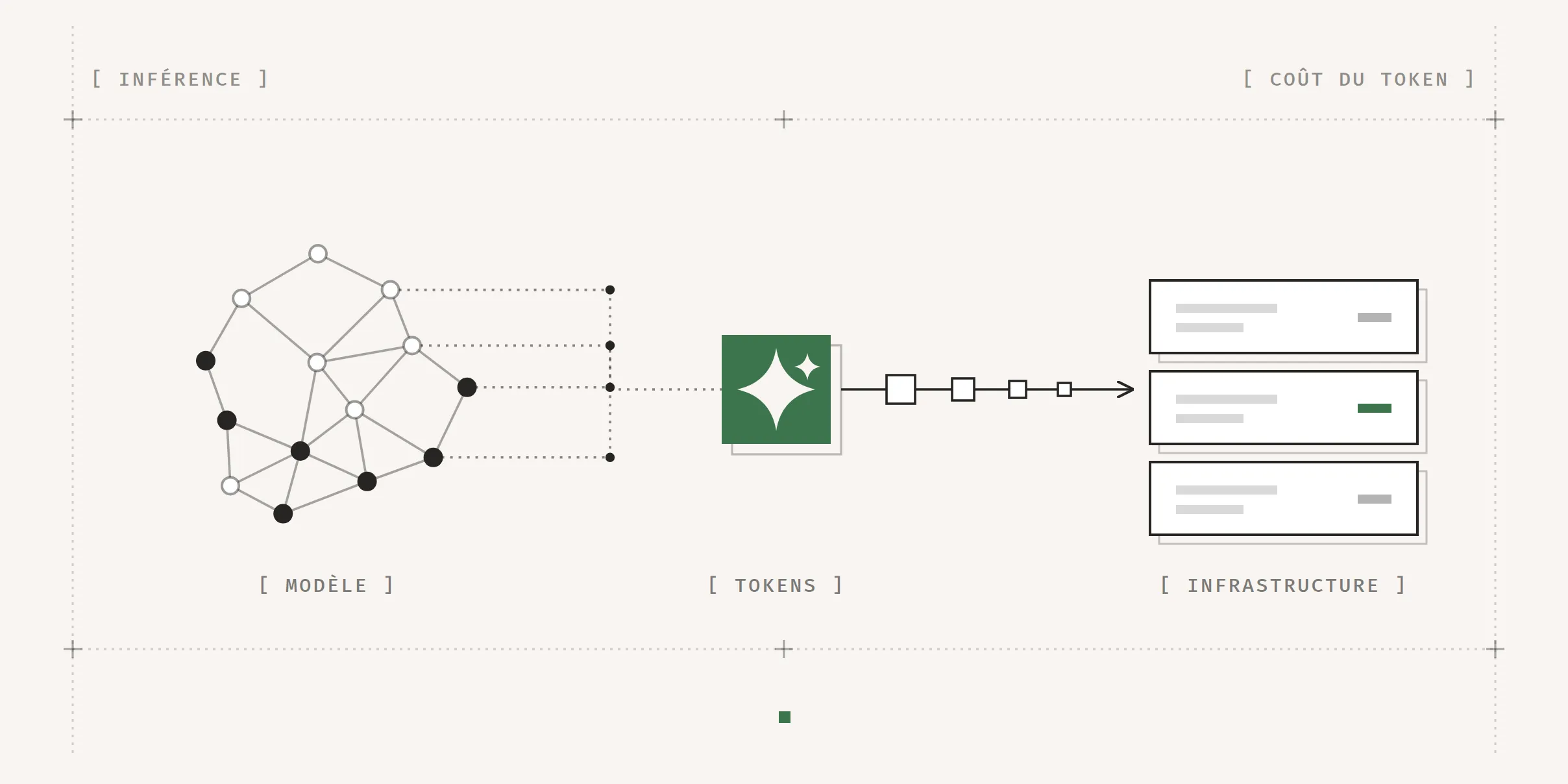
This is the most common misjudgment. Running the inference of an open-source model yourself, i.e., executing queries on your own GPUs, is a costly and demanding profession in its own right :
It requires scale. Without sufficient volume, the marginal cost per request becomes too high and operation is not profitable.
It requires reliability. An inference service must maintain stable latency times, including during peak activity. An API that responds well at night but collapses during rush hour is unacceptable from the client's perspective.
In practice, few players offer this reliability. The recommendation is therefore, most often, to use an inference provider or a cloud provider especially since solutions are generally deployed on the cloud, where the model is used as an integrated service.
The American frontier model market tends to homogenise: a new capability (for example, the flex pricing, which reduces cost by accepting a longer response time) appears at one provider, then at others a few weeks later. This convergence facilitates model changes.
To avoid dependency, two principles:
Remain model-agnostic. An agency independent of AI providers is not incentivised to push one model or another: for each task, it chooses the best value/cost ratio, and can change course along the way.
Rely on an evaluation mechanism. With a reference dataset and metrics (quality, latency, cost), one can switch from one model to another (including in case of a version depreciation by the provider) by checking for no degradation. In fact, changing models generally does not require rebuilding everything.
Proprietary, open-source or sovereign: the comparison
| Criterion | Proprietary (frontier) | Open source | Sovereign (open source hosted in Europe) |
|---|
| Maximum performance | High | Variable, improving | Variable |
| Cost | Higher consumption cost | Manageable | Depends on hosting |
| Security / data location | Good via cloud providers | Good, controllable | Maximum |
| Operating effort | Low (API) | High if self-hosted | High, preferably outsourced |
| Typical use case | Complex, creative tasks, feasibility | Simple tasks, high volume | Regulated sectors, sovereignty requirements |
Hesitating between a proprietary, open-source or sovereign model for your project? Independent of model providers, Galadrim's AI teams evaluate the most relevant solution for each use case in terms of performance, security, sovereignty, and cost for SMEs, ETIs, and large corporations.
About the author
Benjamin Drighès is AI CTO and partner at Galadrim. He created the artificial intelligence and data branch and now manages about forty AI engineers. On a daily basis, he supports SMEs, ETIs, and large corporations in the design and production of AI solutions, with a pragmatic approach focused on business value.
Founded in 2017, Galadrim is a French tech agency that has supported over 800 clients with their custom development and artificial intelligence projects.