ROI of AI in business: what 14 production projects reveal
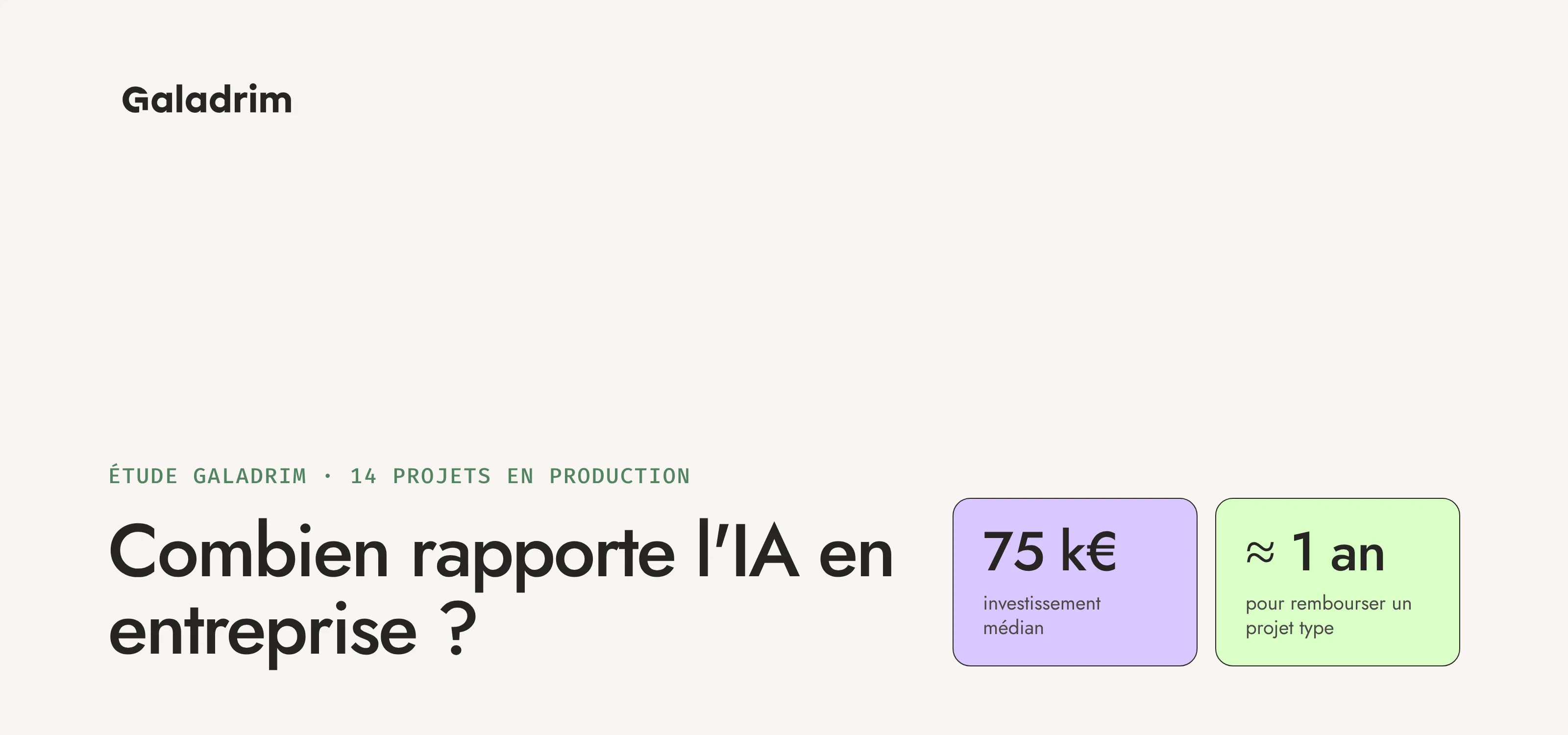
Of 14 generative AI projects deployed by Galadrim for its clients, a typical project costs around 75 k€ to build and pays for itself in about a year. The most profitable ones pay for themselves in 2 to 5 months. All generate a positive monthly gain, calculated with the same formula: volume processed × time saved × loaded hourly cost, minus the cost of AI.
We publish here the results of this internal study, conducted in 2026 by 12 AI engineers from Galadrim. Clients remain anonymous: results are grouped by use case family and by brackets.
In brief
14 generative AI projects in production, analysed one by one by 12 AI engineers from Galadrim.
A typical project costs around 75 k€ and pays for itself in about a year. The best ones, in 2 to 5 months.
The generation of expert documents brings in the most: from 13 to 65 k€ per month and per project.
Formula: volume × time saved × loaded hourly cost, minus the cost of AI.
ROI mainly depends on the choice of task: volume, identified human time, human validation.
How much does an AI project in business bring in?
The 14 projects studied represent 1.4 M€ in cumulative investment. Together, they generate approximately 200 k€ in recurring gains per month, or 2.4 M€ per year. At this rate, the entire portfolio is repaid in 7 months.
Investments range from 30 k€ to 250 k€ per project. Monthly gains range from a few hundred euros to 65 k€. In addition, there is a one-off gain of over 600 k€ from a single project for document stock processing.
≈ 75 k€
median investment per project
≈ 1 year
median payback period
200 k€
in cumulative recurring gains per month
> 600 k€
in one-off gain from a single project
How quickly does an AI project become profitable?
The median payback period is about a year. Nearly one in two projects is paid back in less than 12 months, and 10 out of 13 projects in less than 18 months. The three slowest projects have one thing in common: a low volume, of the order of a few dozen cases per month, or a still preliminary measurement.
Payback period
Number of projects by payback bracket
13 recurring gain projects. The one-off gain project is covered from 5% of the processed stock. Source: Galadrim 2026 study.
The study classifies projects into four families of use cases. Their returns vary greatly.
Use case family
Projects
Monthly gain
Payback
Family Payback*
Generation of expert documents
4
13 to 65 k€
2 to 13 months
5 months
Synthesis, processing and control of files
3
3 to 30 k€
5 to 29 months
7 months
Data extraction and entry
4
less than 1 to 3 k€ + a one-off gain of over 600 k€
13 months and more
24 months
Sorting, routing and business assistants
3
5 to 7 k€
7 to 17 months
12 months
* Cumulative family investment divided by its cumulative monthly gains, excluding one-off gain. Source: Galadrim 2026 study.
Expert document generation: the most profitable family
Technical reports, minutes, product sheets, operational emails. AI produces a first draft, an expert reviews and validates it. Gains range from 13 to 65 k€ per month per project. In one case, a writer's daily output more than tripled.
Example: in a consulting firm, consultants used to spend several days writing each technical report delivered to their clients. AI now drafts a complete first version, which the consultant corrects and validates. Estimated gain: approximately 65 k€ per month, for an investment repaid in approximately 2 months.
Synthesis, processing and control of files
Summaries of voluminous files, pre-qualification before human processing, compliance checks. A 100-page file is summarised in 3 pages: the manager spends 2 hours instead of 2 days on it. The best projects in this family bring in nearly 30 k€ per month.
Data extraction and entry
Document reading and automatic information reporting. Recurring gains remain modest when volumes are. However, for a stock, the gain changes scale: processing several hundred thousand contracts generated over 600 k€ in one-off gain, with the investment covered from 5% of the stock processed.
Sorting, routing and business assistants
Routing of incoming emails to the correct manager, decision support, conversational access to internal data. Regular gains, from 5 to 7 k€ per month, for investments of 50 to 85 k€. To identify suitable tasks within your organisation, see where to start with AI automation.
How to calculate the ROI of an AI project?
Each AI project manager built their formula with the client's teams, documented their assumptions, and entered the results into a common, collectively reviewed repository. The principle remains the same for all projects.
The method
The calculation of monthly gain, applied to the 14 projects
Three indicators summarise each project. The capex : what the project cost to build. The monthly return : the recurring gain, AI cost deducted. The payback : capex divided by the monthly return, i.e. the number of months to repay the project.
Four rules govern the calculation:
the hourly cost used is the actual fully loaded cost of the profession, from approximately 19 €/h (loaded SMIC) to 50 €/h, and the daily cost for expert profiles;
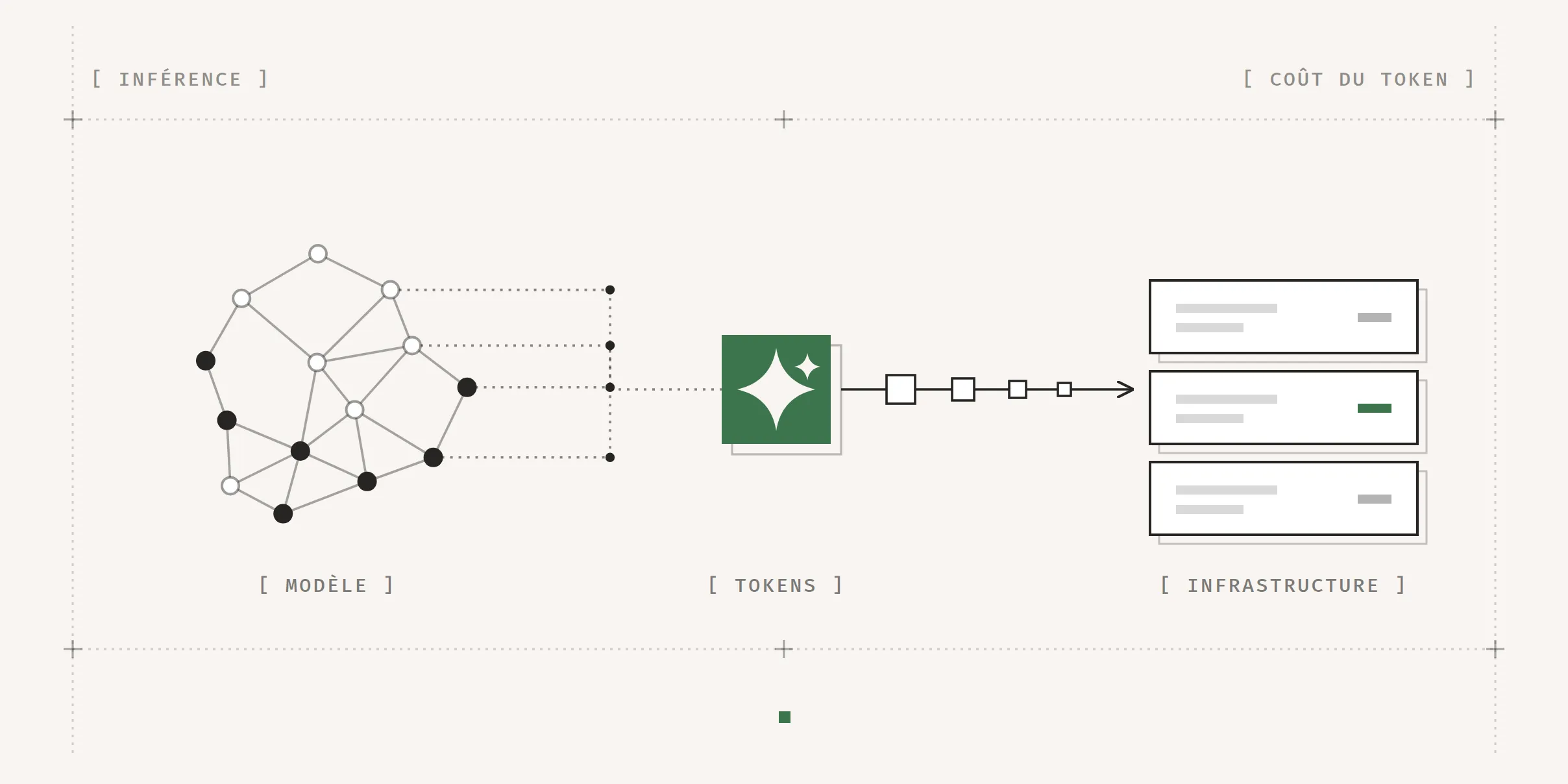
the cost of AI (tokens, infrastructure) is systematically deducted;
one-off gains, such as stock processing, are separated from recurring gains;
when AI provides a new service without replacing human time, it is valued at the price of an equivalent service.
Four characteristics recur in the most profitable projects.
A sufficient and regular volume of documents or files to process.
Clearly identified human time before the project, therefore measurable afterwards.
Validation that remains human : AI drafts, the expert reviews.
A high hourly cost of the replaced task, for example among experts and consultants.
The choice of task matters more than the choice of model. This is the starting point for our missions in AI consulting and transformation.
The limitations of the study
Gains are hours freed up, valued at their cost. Not all of them translate into cash savings: part of the time is reallocated to other tasks. One project is continuously measured in production by a KPI collector; the other 13 are based on formulas and assumptions documented with client teams, which we progressively have validated and then instrumented. Projections assume constant volumes, and maintenance costs are not deducted, unless otherwise stated.
5 key takeaways
All projects generate a positive gain, with a median payback of approximately one year.
Expert documents yield the most : a portfolio repaid in 5 months.
Volume drives ROI : at low volume, repayment often exceeds two years.
A stock to be processed can change everything : over 600 k€ on a single project.
Continuous measurement remains rare : it needs to be instrumented from the moment it goes into production.
Measure before deploying
AI is a means, not an end. Across our 14 projects, ROI is measured in months as soon as the task is well chosen: a real volume, identified human time, and validation that remains human. Do you have a process in mind and want to estimate what it would yield? Let's talk.
FAQ
What is the ROI of a generative AI project?
Across 14 projects in production analysed by Galadrim, a typical project costs approximately 75 k€ and is repaid in approximately one year. Monthly gains range from a few hundred euros to 65 k€ per project. All projects studied generate a positive gain.
How quickly does an AI project become profitable?
The median repayment period is approximately 12 months. Nearly one in two projects is repaid in less than a year, and the most profitable ones in 2 to 5 months. Low-volume projects often exceed two years.
How to calculate the ROI of an AI project?
Multiply the processed volume by the time saved per unit and by the hourly labour cost of the business unit, then deduct the cost of AI (tokens, infrastructure). You get the monthly gain. The payback is the investment divided by this monthly gain.
Which AI use cases are most profitable?
The generation of expert documents (reports, minutes, product sheets) is most profitable: from 13 to 65 k€ per month and per project. Next come the summarisation and analysis of files, then sorting and business assistants. Data extraction is mainly profitable when processing a backlog.
Do you want support to launch your digital project?