With nearly 204 billion downloads worldwide in 2019, mobile applications are now an essential growth driver for many businesses.
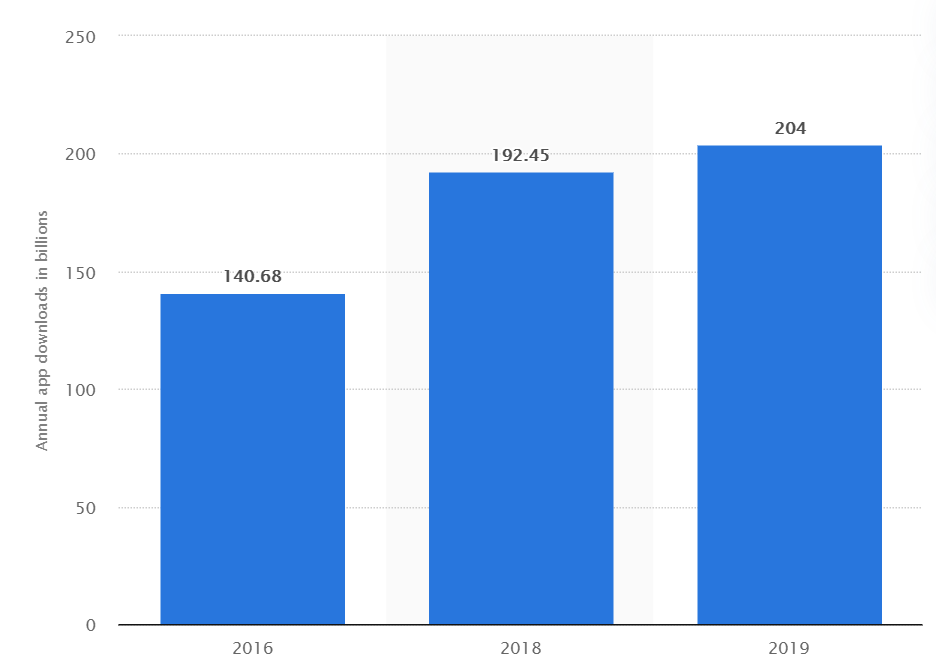
Number of applications downloaded in billions of downloads (source: Statistica)
To give them optimal visibility and usage, stores have become gateways that cannot be bypassed without permanently affecting one's model. However, many project owners often find themselves helpless when faced with rejection from certain stores, even though they hoped to see long-term efforts rewarded.
The App Store thus rejects nearly 40% of all applications submitted to Apple. For what reasons? In the rest of this article, we propose to list the main ones. First and foremost, it is important to bear in mind that Apple is a company that places customer satisfaction at the heart of its project. Rejections are therefore most often linked to an inability, a failure of your application to satisfy the needs of potential users.
Presence of bugs in the application
Apple does not allow any application plagued by bugs to be published on its App Store. It is explicitly recommended that you “ensure you test your application beforehand and correct existing bugs”. Apple’s reputation depends on only accepting functional applications.
Non-functional links
All redirection links in your application must be functional. A link to user support with up-to-date contact information and a link to your privacy policy are required for all applications.
Non-compliant user data access
When you request permission to access user data, you must precisely describe how it will be used. If, furthermore, your application's code references one or more APIs that access user data, a key explaining why your application needs this data must be contained in the Info.plist file.
In this article, Apple details more precisely its requirements in terms of privacy and data usage.
Non-compliant presentation screenshots
The screenshots that will be displayed to the user at the time of download must comply
with the criteria and format imposed by Apple. They must also clearly communicate the purpose and functionalities of your application.
Lack of information allowing Apple to test your application
Apple will ask you for all the information required to test your application properly. For example, if certain functionalities require a user account, you must provide a valid username and password that can serve as a demonstration. If, furthermore, the use of your application requires specific hardware, you may be asked for a test video.
An interface below the standards set by Apple
UX/UI is among Apple's central criteria. Quality design and user experience are necessary. To learn about some best practices, you can consult this
link.
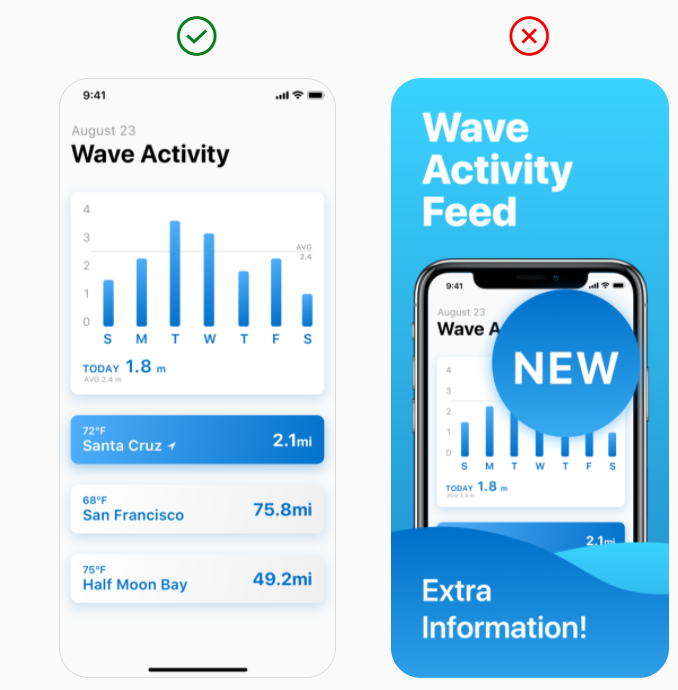
The screen on the right, for example, is invalid here because the text size is less than 11pts and does not allow the user an optimal experience.
Rejection of applications similar to web content
It is stipulated by Apple that your application cannot be assimilated to a single WebView intended for publishing HTML content, or to a simple collection of redirection links to other web pages. If this is the case, it will be rejected.
Too many similar applications published by the same source
If a developer repeatedly offers apps with more or less identical functionalities, Apple will eventually refuse their publication on the Store (
Guidelines 4.3). It is indeed strongly advised against “spamming” the store with multiple variations of the same app.
Discrepancy between the app's description and its actual functionalities
It is necessary that your app's description exactly matches the functionalities it presents.
App payment method not compliant with Apple's criteria
If users can subscribe or purchase different products on your app, it is essential to fully understand the payment standards imposed by Apple Developer. Apple thus mandates, in certain cases, the use of in-app purchases and Apple Pay. This is for example the case if your app offers digital services. The commission taken by Apple for in-app purchases is 30% in the first year and 15% in the second year. For small businesses with a turnover of less than one million euros, Apple's commission is 15% from the first year.
However, when your app offers physical goods or services, you must use other payment methods such as
Stripe. To keep a few good habits in mind, you can consult this
link.
Insufficient content moderation and blocking
Apps allowing users to publish content (e.g., social networks) must enable the moderation and blocking of inappropriate posts. It is, for example, essential to be able to block users whose content has been reported by other users. You can find the details of the recommendations in the
section 1.2 des Guidelines.
Conclusion
Developing an app compliant with Apple's criteria can therefore prove difficult and require meticulous work. This is why we at Galadrim constantly strive to update our knowledge of the standards and best practices made available by Apple Developer. If you have a mobile app project and need advice or development, you can
contact us.

_WoPj3.webp)