I/ Why define an acquisition strategy?
What is its purpose?
The benefit of formalising a clear acquisition strategy is multiple:
Clarifying essential elements that will enable better communication, specifically:
Providing visibility on the budgets to be anticipated for user acquisition.
Saving time by benefiting from a catalogue of relevant actions for each project maturity phase.
When to define your strategy?
The sooner the better – but it's never too late to define your acquisition strategy.
Ideally, this strategy should be formalised as an roadmap acquisition in parallel with the graphic design of the product (mock-up phase). Discussions concerning the personae targeted, the KPIs for success and objectives often help to identify structuring elements that influence the product's value proposition, and therefore its UX, UI, or even its features. It is also beneficial to prepare the official product launch with concrete actions capable of boosting the visibility of this event.
However, it is still relevant to draft an roadmap acquisition after the product launch: this often allows for strategy adjustments and raising the bar in case of insufficient performance.
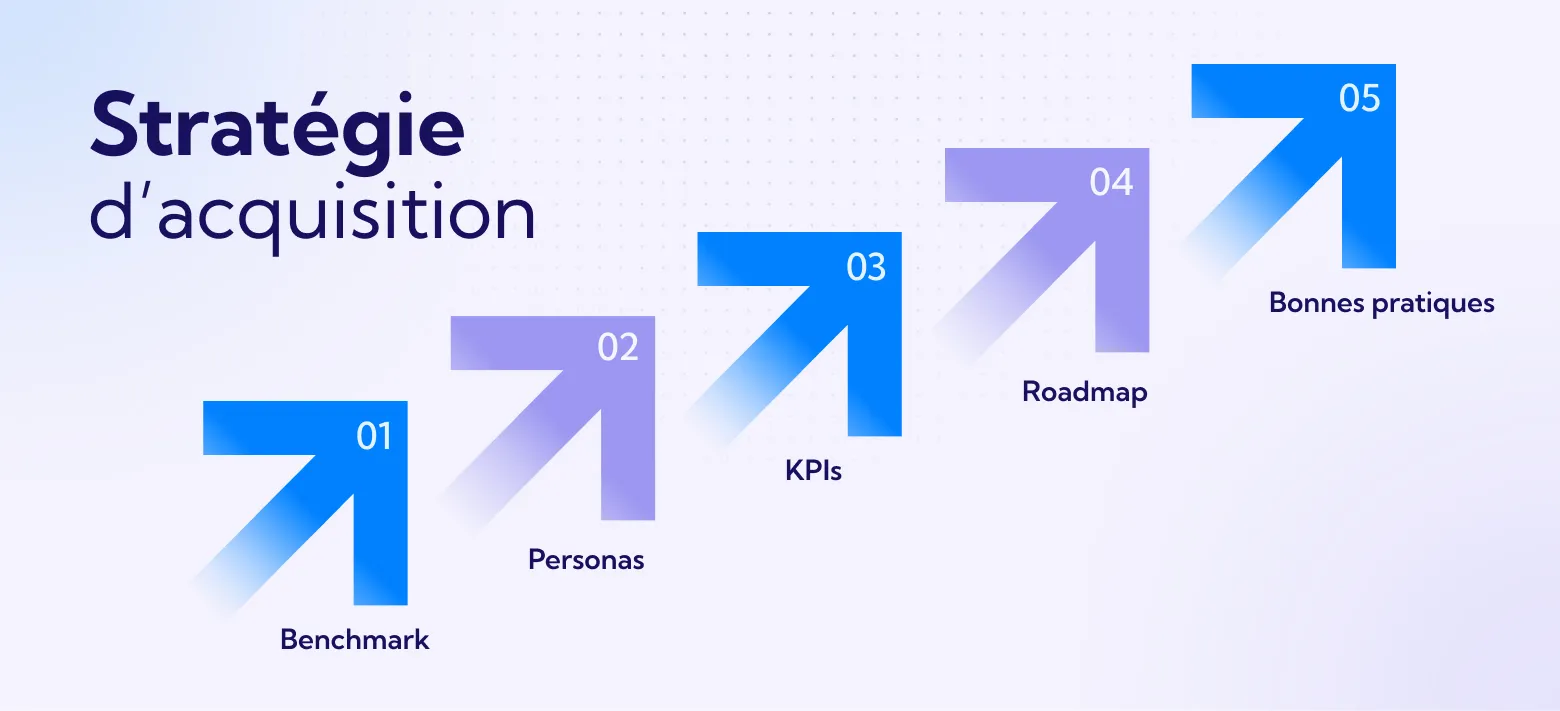
Benchmark
The first step is to carry out a benchmark of competing – or inspiring – solutions.
It is essential to have a clear vision of the competitive landscape in which the product operates – focusing first on direct competitors. Then, an in-depth study of the strategies implemented by competing brands allows for mapping:
The targeted user segments
The acquisition channels used
The magnitudes of traffic or active users
Positioning and differentiating features
On this basis, it is possible to draw up a list:
Of best practices implemented by competitors, which it might be interesting to replicate
Of practices to avoid
Of differentiating elements of your product
This analysis can be supplemented by studying inspiring solutions, or indirect competitors, in order to expand the list of best practices.
Personae
The second step is to establish the list of personae (typologies of targeted users).
This first involves mapping all the journeys offered by the product. To each journey, it is possible to associate one or more personae targets. The profile of each persona is then formalised as a fictional portrait, as precise as possible. This portrait generally includes:
A fictitious identity (first name, age, gender, interests)
An identified problem, which the product addresses
Their use of the product (user journey, frequency of use, time spent, etc.)
The most relevant acquisition channels
It is then important to make assumptions regarding the willingness to pay of each persona - i.e. their presumed appetite for the product. This exercise helps define a priority target, and therefore a preferred communication channel for the initial phases of roadmap acquisition.
This exercise is particularly important for platforms connecting several types of users, as it allows for the definition of an acquisition strategy that takes into account network effects – a phenomenon by which the widespread adoption of a product by one type of user leads to its adoption by other types of users.
KPIs
The third step is to define the KPIs (performance indicators) to prioritise.
Ideally, one should identify a success indicator (referred to as a “primary indicator” or “north star metric”) – which can evolve depending on the product’s maturity phase – and several secondary indicators.
The primary indicator allows one to assess whether the deployed acquisition strategy is effective for each phase of product maturity. For example, a mobile application's primary indicator could be the number of downloads at launch, followed by the number of monthly active users.
Secondary indicators enable the analysis of more targeted elements. For example, for an e-commerce website, the primary indicator could be the revenue generated, and secondary indicators might include the average basket value, the number of items purchased, time spent on the site, etc. It is often pertinent to differentiate secondary indicators based on the product's maturity phase and according to the personae.
Roadmap acquisition
The roadmap is the central resource of the acquisition strategy.
It is a precise plan, compiling a set of actions associated with quantified objectives.
These actions are divided by project maturity phase. Generally, it's pertinent to identify three or four phases of varying lengths – depending on the industry and product life cycle – for example: pre-launch, launch, growth, maturity. Each phase typically spans a period of 2 to 6 months – with a tendency to lengthen as the life cycle progresses. We generally advise concentrating the roadmap over a one-year period, to remain realistic in forecasts – and to build a new roadmap following this period.
These actions are also divided by personae. To each action of the roadmap a budget and an objective are associated, which work hand in hand. The objective takes the form of a KPI quantified – to which it is possible to associate secondary objectives. We advise using rather conservative assumptions so that the roadmap presents reliable projections. The objective is not to list precisely all actions to be taken for each phase of the product life cycle. Rather, it is to compile a catalogue of relevant actions from which to draw during the deployment of the Marketing strategy.
Best practices
The final step is to complete the roadmap with a set of best practices to consider when deploying the acquisition strategy.
These best practices vary depending on the project typology and product maturity stage. They generally concern:
Project confidentiality (for pre-launch phases)
Mobilisation of personal networks
The tone to adopt when presenting the product – an interesting exercise is to summarise the value proposition in one impactful sentence
Preparation for trade fairs
Recourse to specialised communication or Marketing companies
III/ Deploying your acquisition strategy
The roadmap acquisition is deliberately multi-channel as it presents a wide variety of Marketing actions, both physical and digital.
It is therefore necessary to form a multidisciplinary Marketing team. Depending on the project, it may include:
A Marketing expert responsible for the successful execution of the roadmap. Ideally, they will have worked upstream on defining the strategy and possess experience across the various Marketing disciplines involved. They coordinate teams and analyse performance. Their experience enables them to take the right actions at the right time to achieve the set objectives.
An SEO consultant (Search Engine Optimization) responsible for the organic search engine optimisation of the product. Their role specifically involves:
Defining a keyword strategy
Identifying content themes to produce based on this strategy
Optimising the site structure for SEO
Implementing a strategy for backlinks (referencing on partner sites).
A SEA consultant (Search Engine Advertising) responsible for actions related to paid search. This role complements that of the SEO consultant – where relevant – to ensure optimal visibility on search engines (particularly Google via Google Ads).
A consultant Paid Media responsible for paid online advertising – particularly on social media. They implement the actions of the roadmap concerning paid channels, by providing ideas for impactful content.
A consultant Content Marketing responsible for content creation. Based on the conclusions drawn from the analysis of personae, this content can take the form of:
For mobile applications, an ASO consultant (App Store Optimization) can also prove useful to optimise your ranking on online app stores (Google Store and Apple Store).