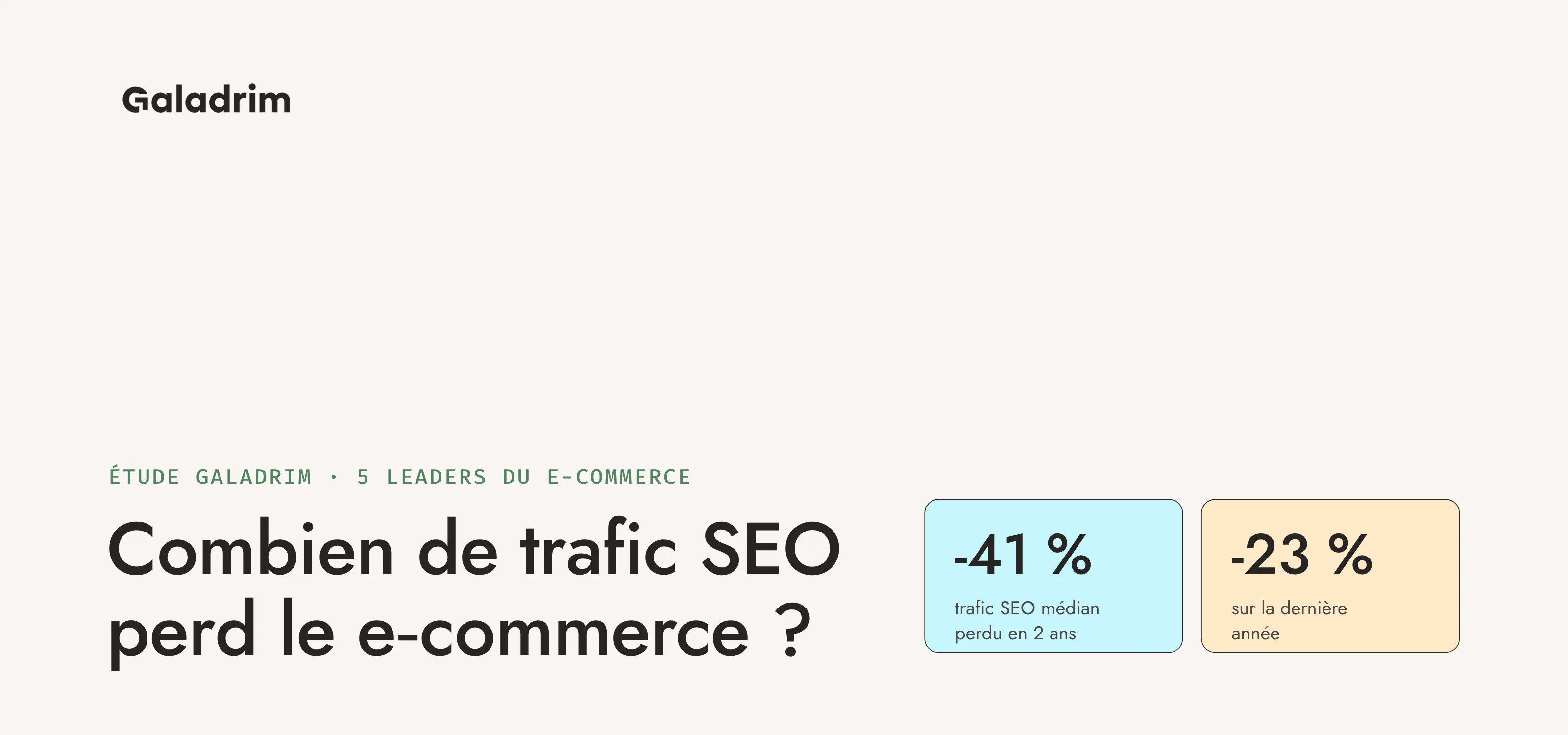
Decline in e-commerce SEO traffic: leaders lose 41% in 2 years
Between early 2025 and late 2026, the five major French e-commerce generalist retailers have all lost organic traffic: -41% as a median, from -19% for Cdiscount to -63% for Rakuten, according to our analysis of estimates Semrush (France base). If your SEO traffic declines, this does not necessarily mean that your SEO is deteriorating. The right reflex: compare your curve to that of your market before drawing conclusions.
In brief
The 5 generalist retailers studied (Amazon, Cdiscount, Fnac, Darty, Rakuten) all lose SEO traffic over 2 years.
Median drop: -41% over 2 years, -23% over the last year alone.
The differences are significant: Darty and Cdiscount stabilise around -20%, Rakuten and Amazon drop sharply.
Before getting alarmed, an e-tailer benefits from comparing its drop to that of its sector and tracking its organic revenue rather than its visits.
The figures: 5 generalist retailers, 5 SEO traffic drops
We recorded the estimated monthly organic traffic by Semrush for five generalist retailers, from December 2024 to November 2026. To smooth out temporary fluctuations, each period is calculated as a three-month median.
Site
Early 2025
Autumn 2026
Over 1 year
Over 2 years
Rakuten
3,5
1,3
-44 %
-63 %
Amazon
95,5
52,2
-33 %
-45 %
Fnac
22,6
13,3
-23 %
-41 %
Darty
9,8
7,8
-16 %
-21 %
Cdiscount
13,5
11,0
+3 %
-19 %
Source: Galadrim analysis, data Semrush (France base, estimated organic traffic in millions of visits per month), collected on 5 November 2026.
Amazon alone lost more than 40 million estimated organic visits per month. Cdiscount is the only one to recover over the last twelve months, without regaining its early 2025 level.
-41 %
median drop in SEO traffic over 2 years
-23 %
median drop over the last year
-45 %
for Amazon, representing over 40 M visits/month
Why e-tailers' SEO traffic is declining
The causes are multiple, and our analysis does not allow us to isolate them site by site. One factor stands out, however: the increasing share of searches that find their answer without a click.
When Google displays an AI-generated summary, internet users click on a classic result in 8% of visits, compared to 15% without a summary, according to a study by the Pew Research Center conducted on 900 American adults in March 2025. These AI overviews arrived in France on 22 July 2026 (The Media Leader).
In our data, the drop accelerates for Amazon and Fnac after summer 2026. The link with this launch remains to be confirmed over several months. The decline had also started long before: other factors are at play, such as competition between marketplaces or Google's algorithm updates.
How to know if the drop in your SEO traffic is 'normal'
A 20% drop can be a good performance in a market losing 40%. Conversely, apparent stability can mask a loss of market share. To gauge your site, four steps:
The method
Gauge your SEO traffic drop in 4 steps
1. Compare yourself to your market. Plot the organic traffic curve of three to five direct competitors in a tool like Semrush or Ahrefs. Your drop then takes on its true meaning.
2. Isolate brand traffic. Searches for your brand name generally hold up better. If your non-brand traffic falls faster than that of the market, the issue is primarily SEO.
3. Track organic revenue. Searches that disappear are often informational and convert little. SEO-generated revenue can hold up even as visits decline: that's what matters.
4. Measure traffic from AIs. In GA4, create a dedicated channel for visits from ChatGPT, Perplexity, Gemini, or Claude. You'll know what compensates for the drop, or not.
Compensate: working on visibility in AI engines
Some product searches now go through AI assistants. Being cited in their answers becomes a full-fledged acquisition channel: this is the purpose of GEO (Generative Engine Optimization). We detail its differences with SEO in our article GEO vs SEO.
For an e-tailer, the concrete levers remain close to good SEO practices: complete and structured product sheets, up-to-date data, customer reviews, content that answers purchase questions. The SEO foundation remains the base. GEO is added to it.
Methodology and limitations
The figures in this study are Semrush estimates, calculated from keyword positions and search volumes. They do not replace actual data from Google Search Console or Analytics. The sample is deliberately restricted to five generalist retailers: it provides a signal on the biggest players, not a measure of all French e-commerce. Finally, an estimated drop can also reflect a loss of positions or a tool recalibration.
4 key takeaways
Leaders are also declining, from -19% to -63% over 2 years according to Semrush estimates.
Compare yourself first : a drop should be read against that of its market.
Organic revenue is a better indicator than visit volume.
AI engines become a channel to be measured and worked on (GEO).
Conclusion
The drop in SEO traffic also affects the biggest players in French e-commerce. For an e-retailer, the challenge is to measure their performance with the right benchmarks (their market, their organic revenue, their AI traffic) then to invest where searches are shifting. Do you want to position your site and build your SEO and GEO strategy? Let's talk.
FAQ
Why is my SEO traffic dropping even though my positions are holding?
With Google's AI overviews, some internet users get their answer without clicking. According to the Pew Research Center, the click-through rate on a classic result drops from 15% to 8% of visits when an AI summary is displayed. For the same position, you therefore receive fewer visits.
Is SEO still profitable for an e-retailer?
Yes, in most cases. High purchase intent searches (product, brand, comparison) still generate clicks. What's changing is the indicator to follow: organic revenue rather than visit volume.
How to measure traffic coming from ChatGPT or Perplexity?
In GA4, create a custom channel group that aggregates referral sources from AI assistants (chatgpt.com, perplexity.ai, gemini.google.com, claude.ai). You can then track their visits and conversions like any other channel.
What's the difference between SEO and GEO?
SEO aims to rank well in Google search results. GEO aims to be cited in AI assistant responses and AI overviews. Both rely on reliable and structured content, and are worked on together.
Do you want support to launch your digital project?