AI and marketing automation: 6 practical use cases and their results
AI-powered marketing automation involves entrusting AI agents or workflows with marketing tasks that previously required a person: drafting a product sheet, sorting an incoming request, qualifying a lead, summarising a document, tracking a brand's visibility. While traditional automation applies fixed rules, AI understands the content it processes. Teams retain decision-making, while AI provides them with more input, faster. Here are 6 use cases from projects conducted by Galadrim, with their results.
In brief
AI automates marketing tasks that required judgment: drafting, sorting, qualifying, summarising.
For an online sales player, the generation of product sheets saved 700 k€ per year.
A SaaS provider went from 8.7% to 43% mentions in AI responses in four months.
The AI projects in our study pay for themselves in seven months on average across the entire portfolio.
What AI is changing in marketing
Web 2.0 made marketing social and measurable. With generative AI, it's changing scale on three levels.
Content. A language model generates a product sheet, an advert, or an email in seconds, in the brand's tone of voice. The bottleneck shifts from production to proofreading.
Data. AI reads what dashboards cannot read: the content of an incoming request, a 100-page file, thousands of AI assistant responses. It transforms text into metrics.
Visibility. Buyers ask their questions to AI assistants. Being cited in these responses becomes a fully-fledged acquisition channel, with its own levers: GEO and, since 31 August 2026 in France, adverts in ChatGPT, which we detail in our guide ChatGPT Ads.
Traditional or AI-powered marketing automation: what's the difference?
Marketing automation tools have existed for a long time: email sequences, point-based scoring, synchronisation between form and CRM. They operate on rules like 'if a prospect downloads a white paper, then send them this email'. Effective, but limited to predictable tasks.
Large Language Models (LLMs) are changing the game. They read a text, understand its intention, and produce an appropriate response. Tasks that required judgment become automatable, with human validation where necessary.
The context. For a major online event sales player, 30 employees were manually drafting product sheets, at a rate of approximately 5 minutes per sheet, with errors and little consistency.
What we did. An application that automatically generates sheets from a sales product list, using LLMs and multimodal models capable of reading visuals. Teams proofread and adjust before publication.
The outcome. 400,000 product sheets generated per year, €700k saved annually, and team productivity multiplied by five.
400 000
product sheets generated per year
700 k€
saved annually
x5
in team productivity
2. Sort and route incoming requests
The context. Contact forms, emails, quote requests: in many companies, someone reads each message to decide who should handle it. Leads wait, the hottest ones cool down.
What AI does. An agent reads each request, identifies its subject and urgency, enriches it with available data and assigns it to the right person, in real-time.
The outcome. In our study on 14 AI projects, sorting, routing, and business support projects generate between €5k and €7k in gains per month each.
3. Powering a platform without re-entry
The context. For an overseas property platform, agencies had to enter their listings one by one on each site.
What we did. Automatic import of agency listing catalogues via SFTP feeds or API, supplemented by AI-powered solvency analysis modules.
The outcome. Over 2,000 listings online and over 1,000 contacts generated by the platform.
4. Producing first drafts of long documents
The context. Reports, studies, commercial proposals: these documents tie up experts for days.
What AI does. It drafts a complete first version based on the company's data and templates. The expert corrects and validates.
The outcome. For a consulting firm, this type of project generates approximately €65k in gains per month, for an investment repaid in about two months. On another project, summarising a 100-page file into 3 pages reduces a manager's work from 2 days to 2 hours.
5. Monitoring your visibility in AI responses
The context. For a carbon footprint SaaS publisher, the brand only appeared in 8.7% of AI assistant responses to its key queries, far behind its competitors.
What we did. Automated monitoring of over 600 queries each month on ChatGPT, Claude, Gemini and Perplexity, mapping of cited sources, then targeted content on subjects where the space was open.
The outcome. In four months, the brand increased to 43% of citations. For a payroll software publisher, the same method doubled visibility on Claude in two months. To go further, read our guide GEO vs SEO.
6. Segmenting each visitor upon arrival
The context. For a large property portal, the inherited tracking did not distinguish professionals from individuals.
What we did. Migration of tracking to GA4 in event-driven mode and automatic segmentation of professional visitors into three business profiles upon entering the funnel.
The outcome. Each professional visitor is identified and tracked until the contact request. This is the basis of any reliable automation: without clean data, AI decides blindly.
AI marketing agent: what are we talking about?
An AI marketing agent is a programme that autonomously chains several actions to achieve an objective: monitor competitors and summarise their new developments, analyse the week's leads, prepare campaign variations. It relies on a language model, accesses your tools (CRM, analytics, ad networks) and reports to a person who validates.
The difference with a simple assistant: the agent acts. Hence the importance of a clear framework (what it can do alone, what it must have validated) and monitoring its results. Our engineers design this type ofAI agents for SMEs, mid-sized companies and large corporations.
Where to start?
Galadrim Method
Launch AI marketing automation
Map your processes. List repetitive tasks, the time they take and the expected gain.
Prioritise by ROI. Start with the most profitable automation, often the one that affects the most volume.
Develop and test. Short deliveries, tests on your real data, human validation where necessary.
Measure and maintain. Hours saved, lead processing time, conversions: indicators set before development.
How much does AI marketing automation cost?
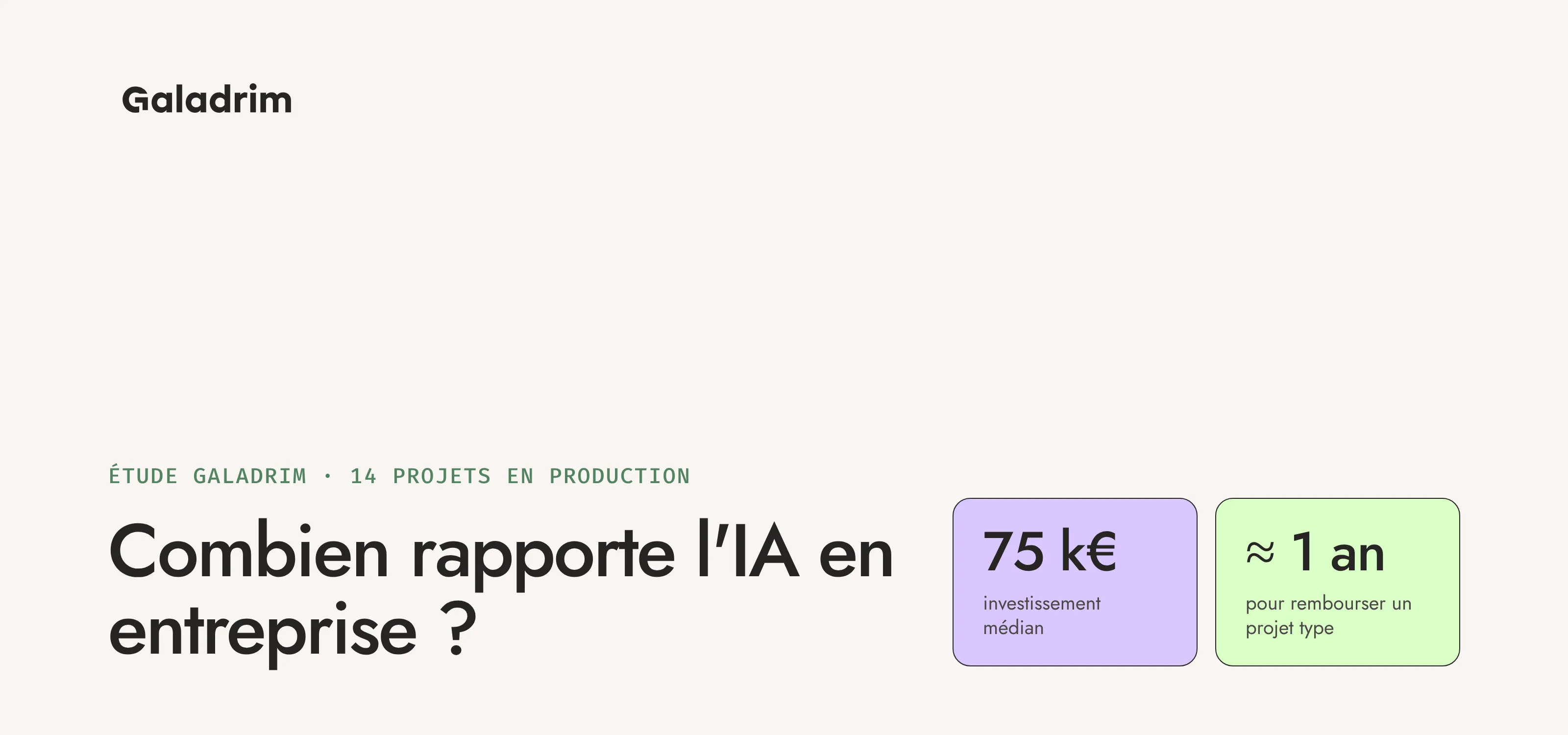
The cost depends on complexity and integrations. Of the 14 AI projects in our ROI study, the investment ranges from €30k to €250k, with a median around €75k. The median return on investment is approximately one year, and seven months across the entire portfolio. The most profitable projects are those that handle a large volume of high-value tasks, such as content or document generation.
The limitations to be aware of
Quality depends on the data. AI fed by a poorly maintained CRM produces false analyses. The first task is often tracking and data quality.
Human validation remains necessary. For published content as well as commercial decisions, a review prevents factual errors and discrepancies in tone.
Data must remain controlled. Hosting, GDPR compliance, model selection: these issues are resolved before deployment.
5 key takeaways
AI extends automation to tasks that required judgment.
Gains amount to : €700k per year on a single content generation case.
Visibility in AIs becomes a full-fledged acquisition channel.
Clean data is the condition for any reliable automation.
We start small, with the use case offering the best return on investment.
About Galadrim. Galadrim is a marketing 3.0 agency : dedicated marketing experts, supported by 150 AI, data, and tech engineers, official partners of OpenAI, Anthropic, and Salesforce. We manage your SEO, your Ads campaigns, your GEO and your AI automations, with one objective: your leads and sales.
FAQ
What is AI marketing automation?
It's the use of AI agents and workflows to take on marketing tasks that previously required a person: writing, sorting, qualifying, summarising, analysing. Unlike the fixed rules of traditional tools, AI understands the content it processes.
How to use AI in marketing?
The most profitable uses today: producing and adapting content, qualifying and routing leads, analysing textual data, tracking and improving visibility in AI responses. The best approach is to start with the use case that involves the highest volume.
What is an AI marketing agent?
A programme that autonomously chains several actions to achieve a marketing objective, relying on a language model and your tools, under the control of a person who validates.
Which tools to use to automate your marketing with AI?
No-code tools and CRMs offer ready-to-use AI components, useful for getting started. As soon as you need to connect several tools, process your own data or guarantee quality, custom development becomes more cost-effective.
Does AI replace marketing teams?
No. In our projects, AI handles volume and repetitive tasks. Teams proofread, validate and focus on strategy and customer relations.
How long does it take to implement initial automation?
A few weeks for a well-defined initial use case, starting with the one that offers the best return on investment.
How to ensure the quality of content produced by AI?
With models fed by your own data and tone, tests on real cases before going into production, and human validation of published content.
Do you want support to launch your digital project?