Business 5 min read -14 March 26-Updated 7 August 26 -Benjamin Drighès
How to create an AI agent?
An AI agent is a system that executes multi-step tasks towards an objective, relying on a language model, tools, and your data. It doesn't just respond like a chatbot: it analyses a request, retrieves useful information, and proposes or performs an action. This is what is called agentic AI. For a business, the question isn't the technology, but the process on which an agent creates a measurable return, and the conditions for it to maintain production.
AI Agent in business: definition, ROI use cases, and the method for moving from POC to production with the right guardrails.
What is an AI agent?
A chatbot answers a question. Classic automation, like RPA, applies a predefined rule: if X, then Y. An AI agent goes beyond that. Starting from an objective, it breaks down the work into steps, chooses the tools it needs (a database search, an API call, reading a document), and produces a result. Between each step, it relies on a language model to interpret the context.
It is this ability to sequence steps and leverage tools that distinguishes agentic AI from previous generations. An agent can process a request that no fixed rule had anticipated, because it reasons about the current case rather than following a script. In return, it requires a framework: without clear boundaries, its scope of action becomes difficult to predict. Hence the importance of guardrails and validation, which we will return to below.
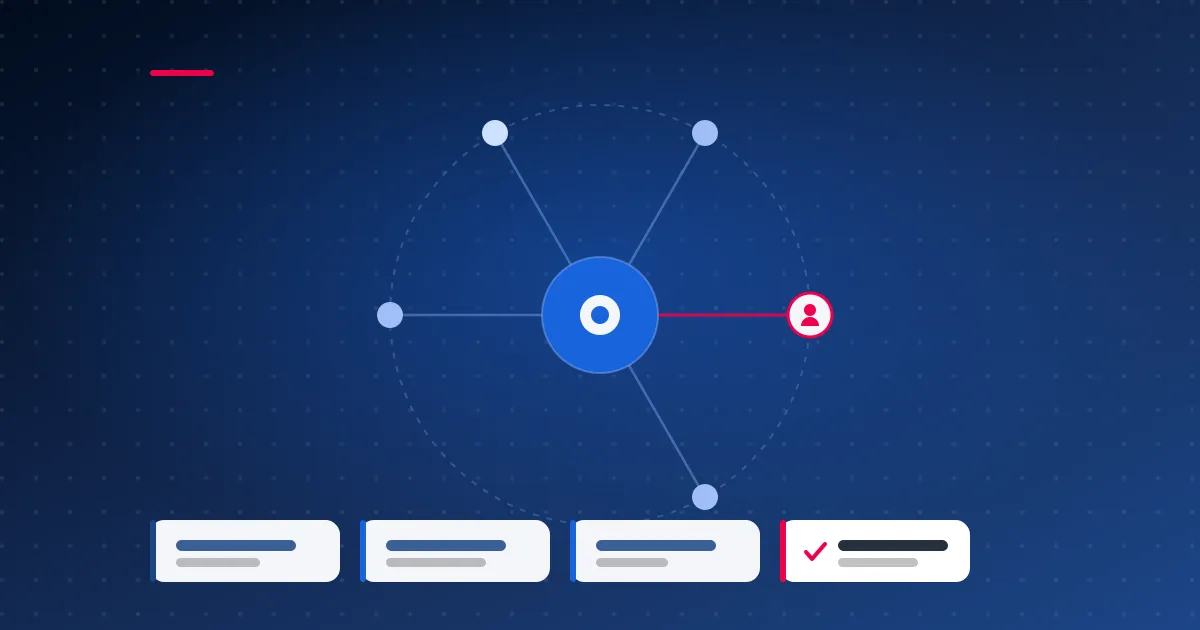
Specifically, an agent always follows the same loop: it starts with an objective, plans the steps, mobilises its tools, proposes an action, and then this action goes through a human checkpoint.
Where does an AI agent create value in business?
An agent comes into its own where volume is high, where information is scattered across multiple systems, and where each case requires a degree of interpretation. Customer service ticks all three boxes: many requests, data distributed across CRM, contracts, and histories, and responses to adapt. Back-office and operations follow the same logic. Conversely, a rare, fully standardised, or critical process without possible supervision is ill-suited to an agent.
Function
What the agent executes
Success condition
Customer service
Classify a request, retrieve the file, draft a response proposal
Validation by a manager before sending
Back-office & operations
Read documents, verify data between systems, prepare processing
Defined data scope and access rights
Sales & pre-sales
Qualify a request, prepare a quote or a response to a call for tenders
Human review of quantified commitments
Expert roles
Gather material, produce a first deliverable to be corrected
The expert retains control over the final decision
This logic aligns with that of AI automation : we start with the process; technology comes next. The agent is one more building block in this toolbox, not an end in itself.
From POC to production: gauging autonomy
The most common pitfall: an agent impressive in demonstration, which never makes it to production. The starting point does not differ from a classic automation project: we choose a precise, high-volume process, and frame the expected gain before writing the first line. This step, common to all automation, is detailed in our guide AI automation: where to begin.
What is unique to the agent is the autonomy granted to it, and it's adjusted like a slider. At startup, the agent merely proposes: it prepares a response, a manager validates everything. As reliability is confirmed within a defined scope, what it can do without systematic validation is expanded. We don't jump from POC to production all at once: we raise the slider notch by notch, monitoring at each level (volume processed, time saved, quality of outputs). To frame this calculation, our method for measuring the ROI of an AI project details the indicators to follow.
Guardrails and governance: the conditions for maintaining production
Gartner attributes the abandonment rate of agentic AI projects to three causes: runaway costs, unclear business value, and insufficient risk controls. The first two are addressed during scoping. The third is addressed through design. An agent in production needs boundaries: a defined scope of action, limited access rights to necessary data, traceability of each step, and a human checkpoint where the stakes justify it.
Validation remains human for committing decisions. The agent prepares, proposes, and saves time; a colleague decides. This distribution is not a temporary crutch; it is the model that allows deployment without transferring the risk to a machine. This is exactly what the following case shows.
Conclusion
An AI agent is only valuable through the process it improves and the return it generates. The rest, the choice of model or framework, comes later. Companies that successfully move into production start with a high-volume use case, scope by ROI, and retain human validation where the stakes demand it. Are you considering a first AI agent, or looking to move a POC into production? Let's talk.
FAQ
What is the difference between an AI agent and a chatbot?
A chatbot answers questions in a conversation. An AI agent executes a multi-step task: it analyses, retrieves information from your systems, and proposes or performs an action. The chatbot dialogues, the agent acts.
Does an AI agent make decisions on its own?
Not on matters that commit the company. The recommended model retains human validation for sensitive decisions: the agent prepares and proposes, a colleague validates. This is what allows deployment without transferring risk to the machine.
How long does it take to get an AI agent into production?
It depends on the process and data access, but the trajectory is consistent: scoping by ROI, prototyping on real data, guardrails and validation, then production deployment with measurement. Better a first agent within a clear scope than several open projects at the same time.
Why do so many AI agent projects fail?
Gartner predicts the abandonment of over 40% of agentic AI projects by the end of 2027, for three reasons: poorly anticipated costs, unclear business value, and insufficient risk controls. Projects that succeed start with a quantified use case and establish their guardrails from the design stage.
What if we want to do it ourselves?
Not all organisations want to outsource. Some prefer to build in-house expertise, at least for the initial use cases. For those who want to understand what goes on behind an agent and no longer be limited by what pre-configured tools allow, Jedha teaches how to build your own AI agents in 75 hours: API calls to large models, agents capable of using tools and executing actions, RAG systems with vector databases, and automation pipelines with n8n. The course culminates in a complete AI application, not just a demonstration. It can be completed in 2 weeks full-time or 6 weeks part-time, and requires no technical prerequisites.
Do you want support to launch your digital project?