What is a Product roadmap?
When starting a web or mobile development project, we are inherently in a state of uncertainty. The Product roadmap provides direction despite this uncertainty. Specifically, it's a visual and chronological representation of the key development stages of a product. It carries the vision and direction of a product, both in the short and long term.
GPS is a good analogy to describe the principle of the Product roadmap, as Bruce McCarthy points out in Product Roadmaps: Relaunched. Between the starting point (the product) and the destination (the goal to be reached), we can go through several stages. To link these stages, GPS chooses a route from different possibilities. However, during our journey, we risk encountering unforeseen events (traffic jams, roadworks...). GPS then suggests new routes to achieve the goal. This analogy is particularly apt, as it demonstrates the evolving (and not fixed) nature of a roadmap. A roadmap must indeed take into account project uncertainties (unanticipated technological complexity, redefinition of needs following new information…), particularly in agile methodology.
5 steps to create your product roadmap
1. Define the project's framework and purpose
Before creating your Product roadmap, you need to be sure why (and for whom) you are building this product. You therefore need to clarify the purpose of your product by identifying:
The need or problem you wish to solve with your product;
The users affected by this need or problem. They can be of several types, and if so, we advise you to categorise them;
How you address this need (your value proposition);
The characteristics and potential constraints of the market concerned;
Your competitors and your differentiation from them
This purpose should remain your North Star throughout the project, especially when building your roadmap. It should also enable you to define your project's objectives.
2. Ideation
The second stage is the ideation phase. It involves generating numerous feature ideas, stimulating creativity. Ideas can then be categorised under different themes, which will be the 'epics' of your roadmap.
We recommend conducting this ideation phase as a team, to value everyone's perceptions and information. Team ideation generally leads to more refined ideas, as each member can build on others' ideas. An ideation phase should always be followed by a sorting phase.
Once your roadmap is built, we advise you to share it with your teams. Indeed, within a company, each department has its own objectives. These objectives can sometimes diverge and create conflicts of interest within the company. For example, the sales function might, to maximise turnover, sell a project abroad even though the application is not available in the relevant language and currency.
3. Prioritisation of your Product roadmap
The backlog
At the end of the ideation phase, you will have a list of unprioritised features. These should be translated into 'user stories'. A 'user story' is usually expressed as follows: 'As a [user type], I can [feature] so that [goal].'
The 'user stories' are then grouped under 'epics', which can correspond to the themes defined during the ideation phase or sub-categories of these same themes. This final list of user stories is called the Product backlog.
How to prioritise your backlog?
There are several backlog prioritisation methods. We advise you to use the one that suits you best, or even to create a blend of them.
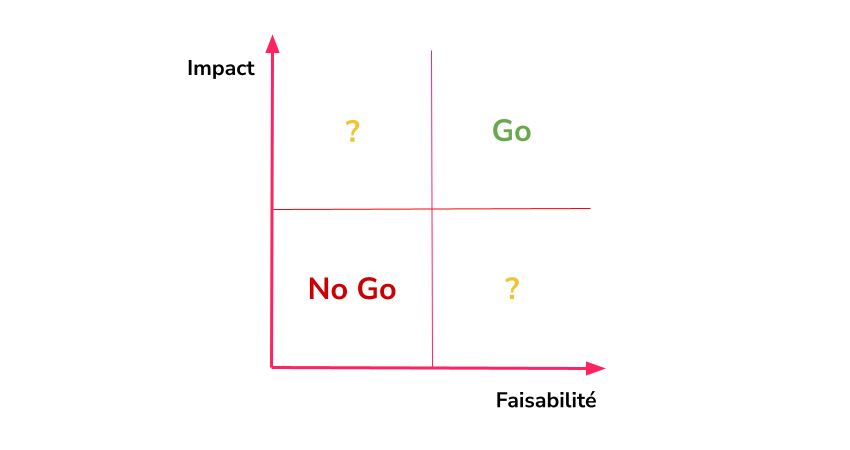
The impact / feasibility matrix involves prioritising features based on their impact on your product's users and the effort required to develop them. At Galadrim, we assign numerical values to each feature to score its impact and feasibility. We use the Fibonacci sequence for this, aiming to reflect the growth of uncertainty in estimation, which goes hand in hand with the complexity of the estimated task.
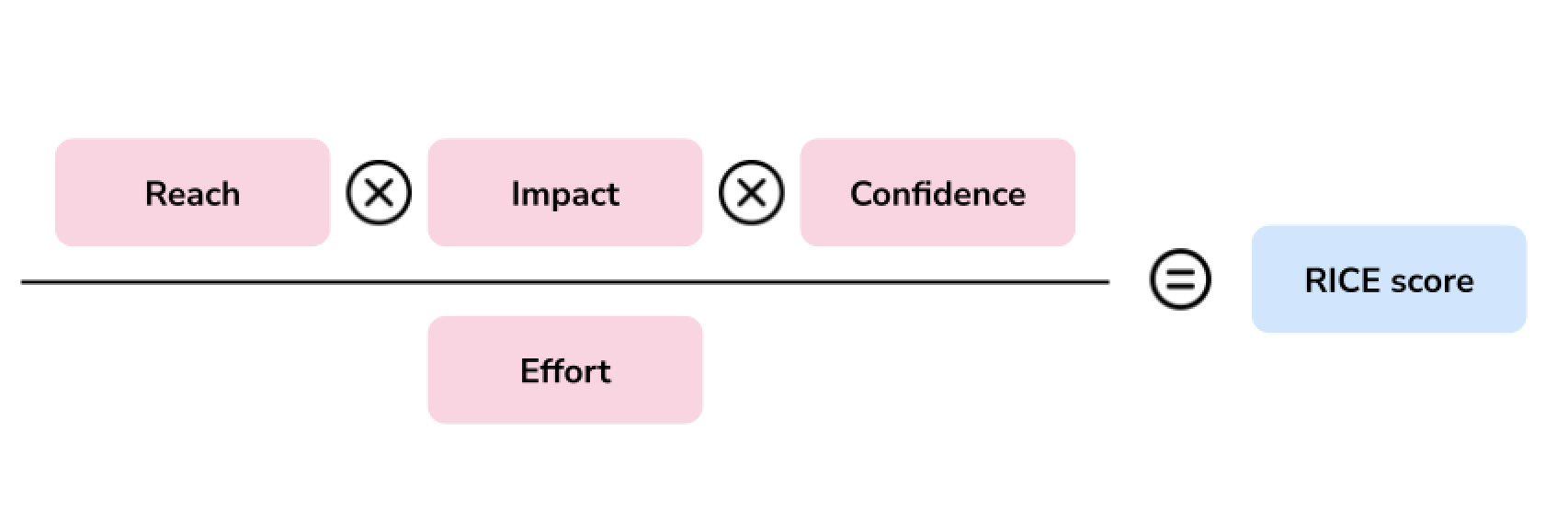
The RICE method is similar but takes more parameters into account. It involves calculating a priority score, based on reach (does the feature benefit many users?), impact, confidence (are there risks? unknowns?) and effort.
The planning poker is a collaborative prioritisation method where each team member assigns a point estimate to each backlog task, based on the perceived complexity of its completion. By bringing together the different estimates, the team can discuss and converge on a consensus for the priority of backlog items. This method fosters collective engagement and offers a more holistic view of task complexity.
Prioritised user stories can then be organised within a Kanban board, as cards. This board allows easy visualisation of all tasks to be completed during the different development phases, as well as their progress status. The Kanban method involves associating each column of the board with a development phase, from design to production (including implementation, pre-production, user acceptance testing...) and moving cards within these columns according to their status.
4. Define and measure objectives
After prioritising the features to be developed and estimating their development time, it is advisable to divide them into development sprints. A sprint corresponds to a fixed unit of time during which a development team works on a defined set of tasks that enable one or more project objectives to be achieved. A key characteristic of the Kanban method is to limit Work In Progress, to ensure that the team focuses on the most crucial tasks.
Objectives must be SMART (Specific, Measurable, Achievable, Relevant, and Time-bound). It is advisable to define KPIs associated with these objectives. KPIs thus enable the results obtained to be measured regularly. By comparing these results with the numerical objectives, you will be able to better define your next objectives and adapt your roadmap accordingly.
For example, if your objective is to increase user retention, a KPI to track could be the number of Daily Active Users and/or their average session time.
5. Make your roadmap evolving
As stated in the introduction, a roadmap is not fixed. It must reflect the changing reality of web and mobile development projects. Regularly adapting your roadmap allows you to remain reactive and ensure that your product evolves in harmony with your users' fluctuating needs and your company's strategic objectives. Be flexible while following the guiding principle that is the purpose of your product!